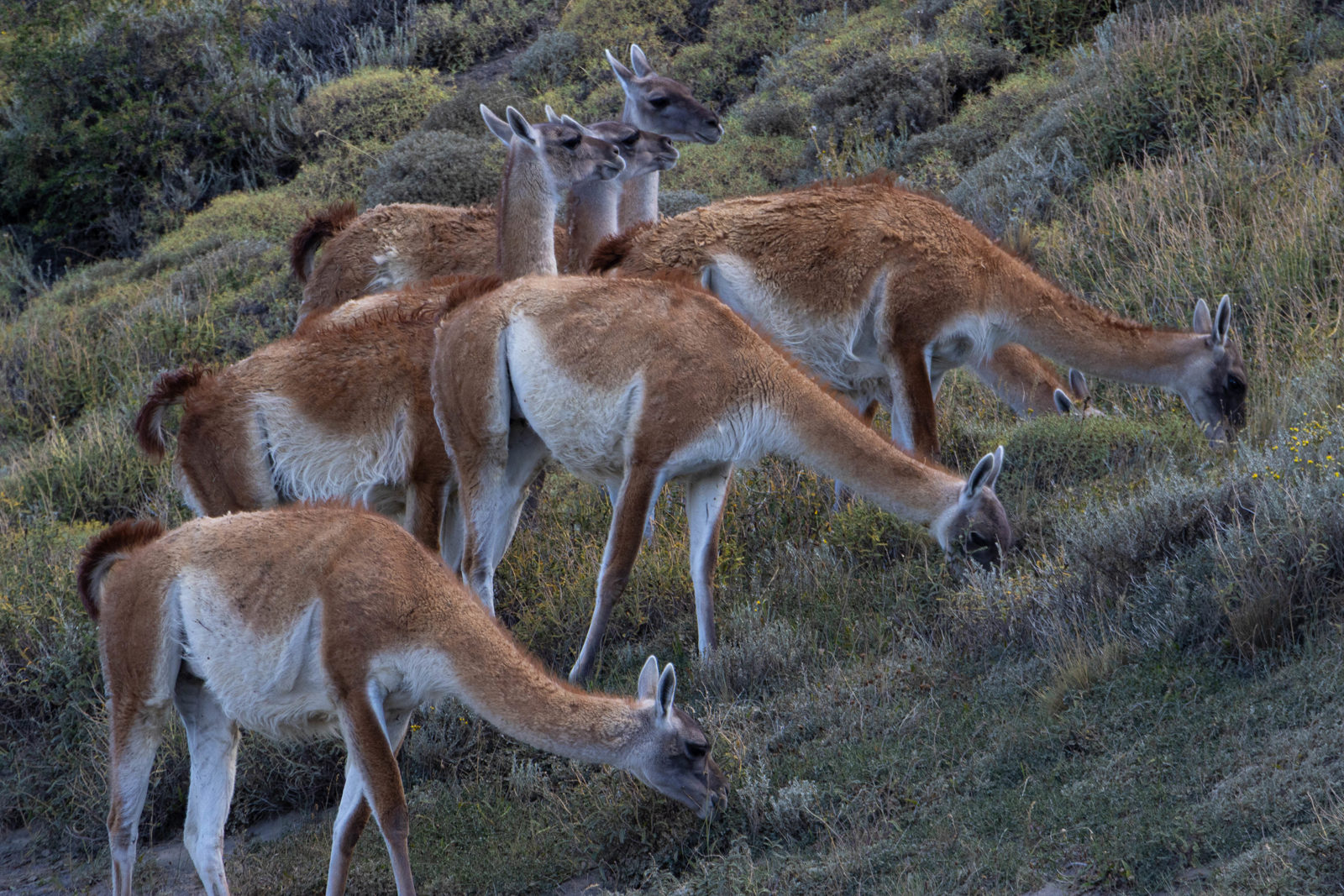
The guanaco (Lama guanicoe) is one of the most characteristic animals of Patagonia and a common sight throughout . A wild relative of the llama, it is perfectly adapted to the harsh conditions of southern South America, where strong winds, cold winters and sparse vegetation challenge many other species.
Guanacos inhabit the open grasslands, shrublands and foothills of the park, often forming family groups consisting of a dominant male, several females and their young. Larger bachelor groups of males are also common. Their thick, soft coat provides insulation against the elements, while their long legs and keen eyesight allow them to detect predators from great distances.
These herbivores play a vital role in the Patagonian ecosystem. They graze on grasses, herbs and shrubs, helping to maintain the balance of the steppe vegetation. Guanacos are also the principal prey of the region's pumas, making them a key part of the park's food chain.
Visitors to Torres del Paine frequently encounter guanacos grazing peacefully against a backdrop of mountains, lakes and glaciers. Their curiosity often allows close observation, making them one of the most rewarding wildlife subjects for photographers. During the breeding season, males can be seen defending territories and competing for mates, while young guanacos, known as chulengos, appear in spring and early summer.
With an estimated population of many thousands within the park, the guanaco has become an enduring symbol of Patagonia's wild landscapes and one of the defining wildlife experiences of any visit to Torres del Paine.
Guanacos are among the easiest wildlife subjects to photograph in Torres del Paine. They are abundant throughout the park and are often relatively tolerant of people, allowing close approaches while still behaving naturally. The best opportunities are usually found in the early morning and late afternoon when the low-angle light adds warmth and texture to their coats and the surrounding grasslands.
Look for opportunities to include the dramatic Patagonian landscape in your composition. Rather than filling the frame with the animal alone, consider showing guanacos against the backdrop of the Paine Massif, Laguna Azul, or the vast steppe to convey a sense of place. Herds can create strong compositions, particularly when arranged along ridgelines or grazing beneath the mountains.
A telephoto lens in the 200–400mm range is ideal for portraits and behavioural shots, while wider focal lengths can be used to place the animals within the landscape. Guanacos are highly alert, frequently raising their heads to scan for danger, providing opportunities for striking profile images. During the breeding season, watch for displays of territorial behaviour, while spring offers the chance to photograph young chulengos alongside their mothers.
Patience is often rewarded. By observing a herd for a period of time, you can anticipate interactions, movement, and moments when an individual pauses to look directly towards the camera. These brief moments of eye contact can create particularly engaging wildlife photographs.