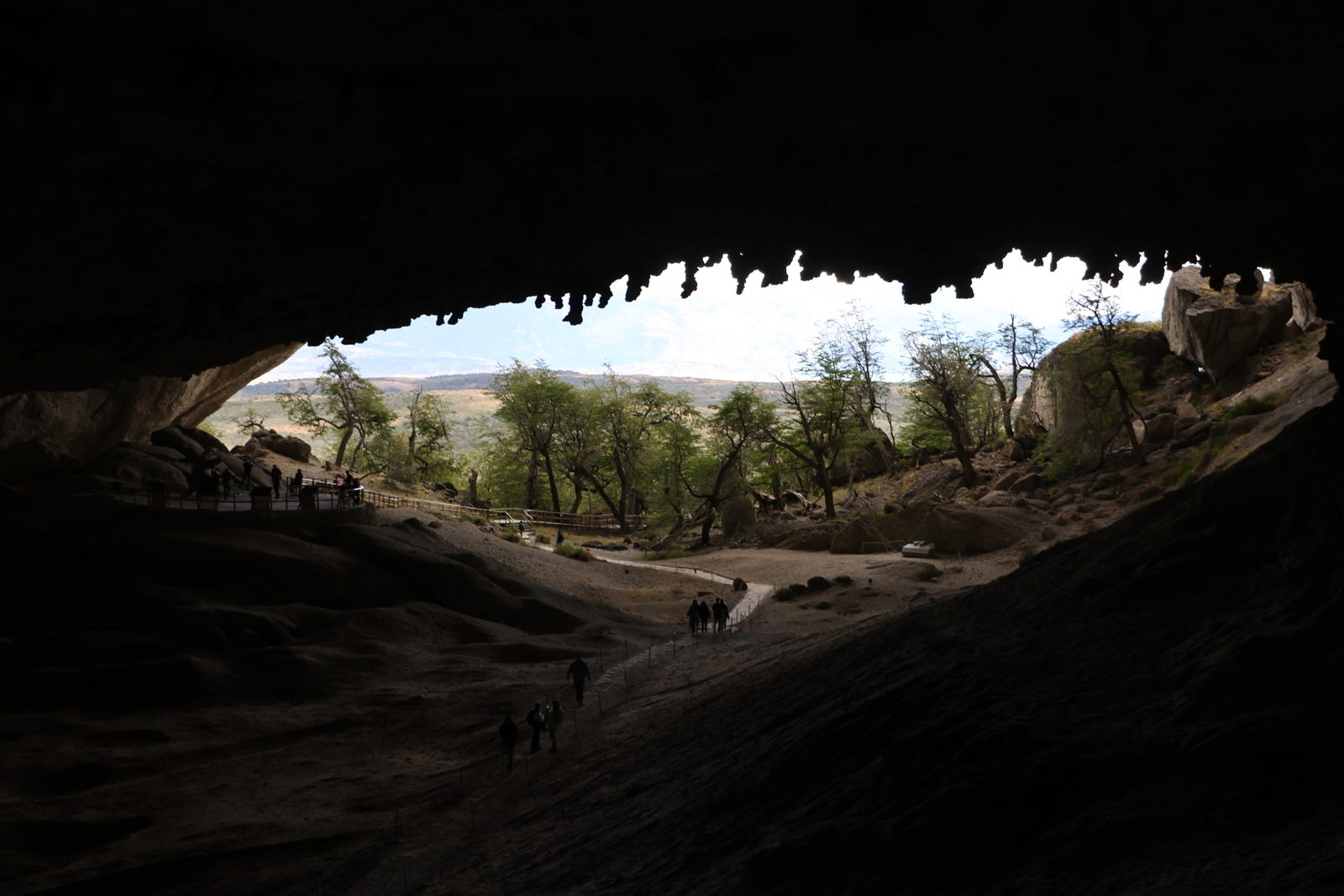
View from inside Cueva del Milodón cave towards the Patagonian landscape near Puerto Natales, Chile
Story Day

Cueva del Milodón

Day 5 / 2/16/2026

Before heading deeper into Torres del Paine, we visited Cueva del Milodón near Puerto Natales — a vast prehistoric cave famous for the discovery of giant ground sloth remains and surrounded by dramatic Patagonian scenery.

We’d hired a car for six days to explore Chilean Patagonia, and Cueva del Milodón was our first stop after leaving Puerto Natales. It felt like a gentle introduction to the landscapes ahead: woodland trails, wide mountain views and a vast cave linked to one of Patagonia’s most famous prehistoric discoveries.

This enormous cave became world-famous after the discovery of remarkably well-preserved remains of the giant ground sloth, Mylodon darwinii, an Ice Age mammal that roamed Patagonia more than 10,000 years ago.

The site is much more than a single cave. A network of trails leads through native woodland, past dramatic rock formations, and into the vast cavern itself. Standing beneath the huge entrance, it's easy to imagine a very different Patagonia, inhabited by giant mammals that disappeared at the end of the last Ice Age.

The cave also offers spectacular views of the surrounding mountains, making it an excellent introduction to the rugged landscapes that define this remarkable region.

Notes

Is Cueva del Milodón worth visiting?

Cueva del Milodón is an easy and worthwhile half-day trip from Puerto Natales, especially if you have a car and want a gentle introduction to the landscapes north of town. The main cave is the highlight, but the longer trail adds woodland, open views, smaller caves and a good chance of seeing local birdlife. It works particularly well as a first stop before heading deeper into Torres del Paine.

Photo Diary

Our visit began with the short drive from Puerto Natales to Cueva del Milodón Natural Monument. At the entrance, the mountains behind the sign already hinted at the wider Patagonian landscape surrounding the cave.

Journey / driving

Puerto Natales to Cueva del Milodón

25.5 km

Route prepared with FOSSGIS OSRM. Report a map issue.

Entrance to Cueva del Milodón Natural Monument near Puerto Natales.
Jagged peaks rise above the forests of southern Patagonia, their snowfields and rocky ridges shaped by millions of years of glaciation and weathering. Beneath the ever-changing skies, the mountains create a dramatic landscape where sunshine, rain, and cloud can all arrive within the space of an hour.
The walk up to Cueva del Milodón gave us our first real taste of the Patagonian landscape, with jagged peaks, fast-changing cloud and wild forest surrounding the cave trail.
The vast entrance of Cueva del Milodón provides a dramatic glimpse into Patagonia's prehistoric past. It was here in 1895 that remarkably well-preserved remains of the Giant Ground Sloth (Mylodon darwinii) were discovered, bringing worldwide attention to this enormous cave. Today, visitors can walk through the cavern and imagine the Ice Age world that once existed beyond its entrance.
Standing inside Cueva del Milodón, it is easy to imagine why this huge natural shelter became so closely associated with Patagonia’s Ice Age past.
Standing over three metres tall when reared up, the Giant Ground Sloth roamed Patagonia until around 10,000 years ago. Discoveries made in nearby caves, including remarkably well-preserved skin and bones, provided some of the best evidence ever found of this extraordinary Ice Age creature. Today, reconstructions such as this help visitors appreciate the scale of one of South America's most iconic extinct animals.
Standing beside the giant ground sloth reconstruction inside Cueva del Milodón really brings home the scale of the Ice Age animals that once roamed Patagonia.
A wide view inside Cueva del Milodón near Puerto Natales, showing visitors walking beneath the enormous rock ceiling and giving a sense of the cave’s impressive scale.
Embedded within the sedimentary rocks of Patagonia, this rounded concretion was formed millions of years ago as minerals accumulated around a central core. Weathering has gradually exposed the harder structure, revealing a natural geological feature that resembles a giant stone sphere set within the cliff face.
Not everything at Cueva del Milodón is about the giant ground sloth — the cave walls themselves are full of strange shapes, textures and geological details.
After visiting the main cave, we followed the longer 7 km loop through open scrubland and woodland to see two smaller caves and wider views across the surrounding landscape.
Away from the main cave, the trail opened out to wide Patagonian views, with lakes, layered hills and distant peaks stretching away under a heavy sky.
After the main cave, we followed the trail out into open scrubland, where the landscape felt wilder and much quieter away from the main visitor area.
One of Patagonia's most familiar birds, the Austral Thrush can be found from forests and grasslands to windswept scrub. Its rich song is a characteristic sound of southern Chile and Argentina, while its adaptability allows it to thrive even in the region's challenging weather conditions. These photographs capture a typical Patagonian scene, with the bird perched among the low vegetation and twisted branches that define this rugged landscape.
An Austral Thrush among the low Patagonian vegetation around Cueva del Milodón, one of the common birds seen while walking the trails beyond the main cave.
Among the trees around Cueva del Milodón, Austral Thrushes were easy to spot, adding a small wildlife moment to a walk mostly shaped by caves, rock and wide Patagonian views.
Draped from branches like strands of silver-grey hair, Old Man's Beard lichen thrives in Patagonia's clean, unpolluted air. A partnership between fungus and algae, it grows slowly over many years and is often considered an indicator of a healthy forest ecosystem. These delicate, tangled forms add texture and character to the ancient woodlands of southern Chile and Argentina.
The woodland around Cueva del Milodón had its own atmosphere, with Old Man’s Beard lichen hanging from the branches like pale threads in the damp Patagonian air.
Close-up details like this Old Man’s Beard lichen gave the woodland around Cueva del Milodón a wild, ancient feel, matching the prehistoric atmosphere of the caves.
The Chimango Caracara is one of Patagonia's most familiar birds of prey. Highly adaptable and opportunistic, it can often be found around campsites, car parks, and towns searching for scraps of food. Much like seagulls in coastal areas, these intelligent birds have learned that people often provide an easy meal.
A Chimango Caracara perched in the damp Patagonian weather near Cueva del Milodón, one of the opportunistic birds often seen around trails, car parks and open country in southern Chile.